
Research Library · Parents and teachers
Do colored overlays help with dyslexia?
Do colored overlays, Irlen lenses or dyslexia glasses help a child read? Good tests have not shown it. A placebo color did just as well. Here is the research.
5 studies · Every fact checked against its source
Watch the answer
Read the video transcript
Someone says a colored sheet could help your child read. Colored overlays, Irlen lenses, dyslexia glasses. Do they work?
The claim: for some children, print seems to blur or move, and the right color eases it.
Not that anyone has shown. A review of 51 studies found little evidence that color helps reading.
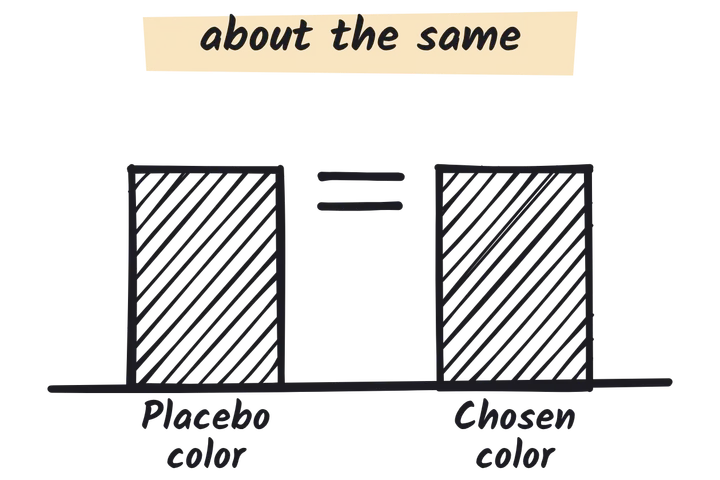
In well-masked trials, a chosen color did no better than a placebo color.
That is not proof it never helps. The studies were weak, and better ones are needed.
Even researchers who favor colored filters write that they are not a treatment for dyslexia.
The reviews advise an eye exam first, to rule out vision problems. And what fair tests do back is teaching reading itself.
So when someone offers a colored sheet, you'll know what to ask.
The 30-second answer
8 cards. Tap the arrow for the next one.
The short answer
Not shown to work. In well-masked trials, a chosen color helped reading no more than a placebo color.
What is Irlen syndrome?
A name for print that seems to blur, move or glare. The two main diagnosis manuals do not list it, one review notes.
What are colored overlays?
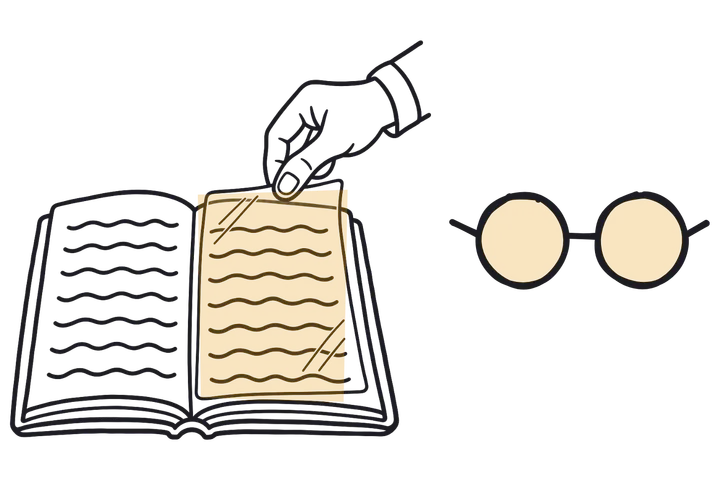
Sheets of colored plastic laid over the page. Tinted glasses are built on the same claim.
Why do some people say it helps?
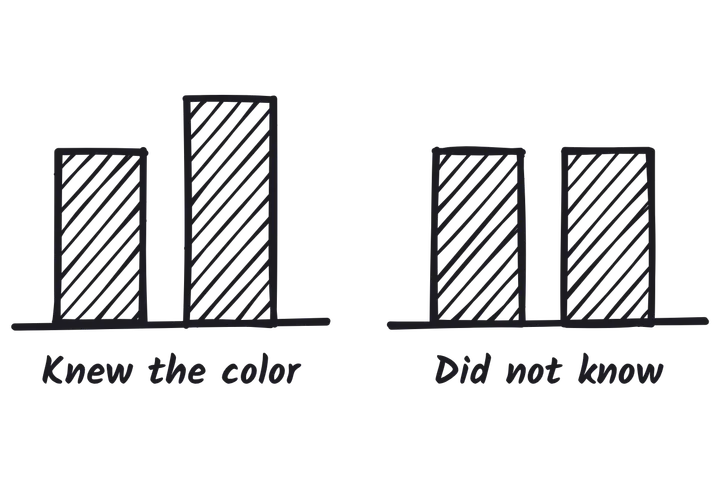
Most likely a placebo effect, reviewers say. Studies where people knew their color often found gains. Well-masked ones did not.
Do they treat dyslexia?
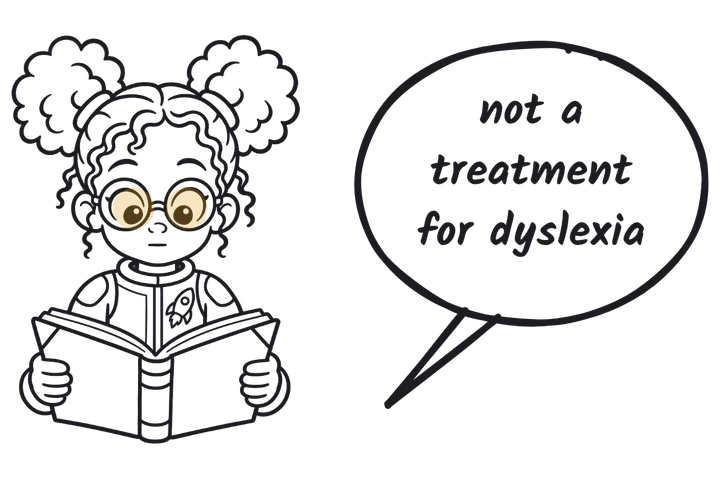
No. Even researchers who favor colored filters write that they "are not a treatment for dyslexia".
Do all reviews agree?
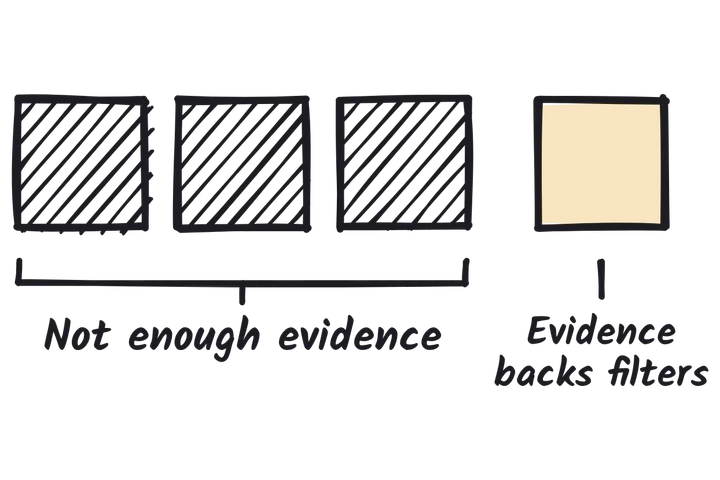
Three of four reviews found too little good evidence. One found that the evidence does back filters.

Is the question closed?
No. Weak evidence is not proof of no effect. Reviewers say better trials are needed.

What the reviews advise
The reviews advise an eye exam first, to rule out ordinary vision problems. What fair tests do back is teaching reading itself.
The studies behind this answer
5 studies at a glance. Tap one for its Study Facts.
- Griffiths and others, 2016Review of 51 studiesLittle evidence that color improves reading. Gains were small, or no bigger than with a placebo.Moderate
- Suttle and others, 2018Review of 4 earlier reviewsThree of four reviews found too little good evidence. Overall: no reliable evidence yet.Moderate
- Galuschka and others, 2014Pooled review of 22 trialsOnly phonics had a confirmed gain. For colored overlays and lenses, the gain could be chance.Moderate
- Miyasaka and others, 2019Review of 45 studiesA "lack of evidence" that Irlen syndrome exists as described, or that colored lenses treat it.Limited
- Evans and Allen, 2016Review of trials of one filter systemAll 10 overlay trials found a gain. The "balance of evidence" favors filters, the authors say.Limited
Evidence: Strong many fair tests agree · Moderate good but not settled · Limited few or weak tests · Expert view experts reading other research, no new test
What is Irlen syndrome?
Irlen syndrome is a name for trouble seeing print. People say the words blur, move or double. They say the page glares. Some get headaches or eye strain when they read. Other names for it are Meares-Irlen syndrome, scotopic sensitivity syndrome and visual stress.
The name comes from Helen Irlen, an American psychologist, the 51-study review explains. In 1983, it says, she argued that this was one reason why some children have trouble learning to read.
The two main diagnosis manuals do not list it, a 2016 review notes.
Colored overlays for dyslexia
A colored overlay is a sheet of tinted plastic. It is laid over the page. The claim: the right color eases the symptoms, and reading gets better.
Dyslexia glasses and Irlen lenses
These are glasses with tinted lenses. The claim is the same. Research groups do not agree on which colors help, the 2018 overview notes.
What the colored overlay studies found
Little evidence that color helps reading. In 2016, four researchers reviewed 51 studies of colored overlays and lenses. They found "little evidence" that color improves reading. That held for every system, Irlen lenses too.
A placebo did about as well. Many studies did report gains. But the gains were small, or no bigger than with a placebo color. In well-masked trials, the chosen color did no better than the placebo. Most studies had a high or unclear risk of bias. The ones at lower risk gave color less support.
Fair tests did not confirm it. A 2014 review pooled 22 trials of help for children with reading disabilities. Four comparisons tested colored overlays or lenses. Their gain could be chance. Against a placebo, it was negligible. Only phonics had a confirmed gain. But phonics had many more trials, and the treatments did not differ reliably.
Three of four reviews agree. A 2018 overview compared four reviews. Three found too little good evidence to back overlays or lenses. One found that the evidence does back them.
The one review in favor. That 2016 review looked only at people picked as having visual stress, and at one filter system. All 10 overlay trials it counted found a gain. Its two authors say the "balance of evidence" favors filters for such people. They add two limits. Overlay trials cannot be masked. And larger trials are needed. One author is the unpaid secretary of a colored lens society. The 2018 overview calls their conclusion "surprising", given the limits they admit.
Not a treatment for dyslexia. Even the two authors in favor write that colored filters "are not a treatment for dyslexia".
Irlen syndrome itself. A 2019 review looked at 45 studies. It found a "lack of evidence" that Irlen syndrome exists as described. It found the same for the lenses as a treatment. 14 studies favored the lenses. 14 found the opposite. The authors could not fully rule the symptoms out.
The question is not closed. Weak evidence is not proof of no effect, the 2016 reviewers stress. The overview agrees. "It is possible that they are effective", it says, but that "is not yet known".
What to do if reading is hard for your child
What the reviews say:
- Have the eyes checked first. Reviewers on both sides say an eye exam should rule out ordinary vision problems before any colored filter is tried.
- Put the time into reading itself. Working directly on reading skills is effective, the 2014 review concludes. Phonics was the one approach with a confirmed gain.
- Count the cost. Filters cost money, time and raised hopes, the review in favor notes. The 51-study review warns that they may delay the right help.
- Ask for the evidence. Those who offer filters should take care not to overstate the case, the review in favor says.
- If your child already uses an overlay. It is unlikely to harm health, the overview says. Most studies showed use falling away over time, the 51-study review adds.
This page is not medical advice. If you worry about your child's eyes, see an eye doctor.
Know a parent or teacher who is asking about this?
Go deeper
The background, section by section. Tap a section to open it.
1Is Irlen syndrome real?
People do report these symptoms. The doubt is about the syndrome as described, its tests and its treatment.
- The tests. The 2019 review found ten tests for Irlen syndrome. Seven were proprietary and patented. It calls the tests "at least questionable".
- Test and treatment overlap. Colored lenses were also one of the tools used to decide who has it, the 2019 review notes.
- Who gets the label. In studies that used the Irlen method, 46% to 96% of those tested were labeled, the 51-study review found. Both normal and poor readers were labeled at high rates, it adds.
- Too many, supporters of filters say. The Irlen approach "over-diagnoses the condition", the review in favor writes.
- Only Irlen filters? Helen Irlen's book argues that only her institute's filters work, the 51-study review reports. "No scientific evidence supports this claim", it writes.
We have not read Irlen's book or test materials. We report these points as the reviews tell them.
2Why this matters to you
A parent wants help that works. Claims of a treatment are appealing, the 2018 overview notes.
3How the studies were done
Which studies we used
- 2016: a review of 51 studies of colored overlays and lenses.
- 2018: an overview of four earlier reviews.
- 2014: a pooled review of 22 trials of help for reading disabilities.
- 2019: a review of 45 studies of Irlen syndrome.
- 2016: a review in favor of filters. 10 overlay trials and 3 lens trials of one system.
One paper we wanted was not free to read: the joint statement on dyslexia and vision by U.S. pediatricians and eye doctors. Those groups do not recommend colored lenses for reading problems, the 2019 review reports. We have not read their statement.
What was measured
Reading speed, accuracy and understanding. Some studies used a speed test made of small, crowded words. It is not meant as a test of reading ability, the 51-study review notes.
Who was measured
Children and adults. Some were poor readers. Some were picked for visual stress.
How it was measured
The best trials compared a chosen color with a placebo color. People did not know which was which. Most studies did not do this.
The 51-study review did not pool its studies into one number. They were too weak for that.
Who did the studies, and who paid
Each study's label at the top of this page shows who did it and who paid.
One author of the review in favor has been paid for lectures on the topic. And one author of 10 of the 45 Irlen studies holds patents in this field, the 2019 review notes.
4For teachers
Scores on the crowded-word speed test jump about. In one study, children took it twice with no overlay. The second time, 12.3% read more than 15% faster.
5Questions parents and teachers ask
Can glasses help with dyslexia?
Tinted glasses have not been shown to help reading. An eye exam can find ordinary vision problems.
What color overlay is best for dyslexia?
No color has good evidence behind it. Research groups do not agree. Some say blue or yellow. Others say any color.
Is dyslexia a vision problem?
The review in favor of filters says no. The likely causes of poor reading in dyslexia are not visual, it writes.
Is visual stress the same as dyslexia?
No. It is "distinct from" dyslexia, that review says. The two sometimes occur together.
Are colored overlays harmful?
They are unlikely to harm health, the 2018 overview says. It points to other costs: money, raised hopes and other help left untried.
SSources and the exact numbers
- P. G. Griffiths, R. H. Taylor, L. M. Henderson and B. T. Barrett, “The effect of coloured overlays and lenses on reading: a systematic review of the literature”, Ophthalmic & Physiological Optics 36(5), 2016, pp. 519–544.Free peer-reviewed manuscript, University of Bradford; DOI 10.1111/opo.12316. For researchers: 51 published items, 54 data sets, 2,690 participants (23 Intuitive, 15 Irlen, 4 ChromaGen/Harris, 12 other); no pooled estimate.
- C. M. Suttle, J. G. Lawrenson and M. L. Conway, “Efficacy of coloured overlays and lenses for treating reading difficulty: an overview of systematic reviews”, Clinical and Experimental Optometry 101(4), 2018, pp. 514–520.Free accepted manuscript, City, University of London; DOI 10.1111/cxo.12676. Four systematic reviews (Albon 2008; Evans and Allen 2016; Galuschka 2014; Griffiths 2016); protocol PROSPERO CRD42017059172.
- Katharina Galuschka, Elena Ise, Kathrin Krick and Gerd Schulte-Körne, “Effectiveness of Treatment Approaches for Children and Adolescents with Reading Disabilities: A Meta-Analysis of Randomized Controlled Trials”, PLoS ONE 9(2), 2014, e89900.Free (open access); DOI 10.1371/journal.pone.0089900. For researchers: 22 randomized trials, 49 comparisons (1,138 children in treatment groups, 764 in comparison groups); coloured overlays: 4 comparisons, g' = 0.316 (95% CI -0.012 to 0.644), not significant; phonics instruction: 29 comparisons, g' = 0.322 (95% CI 0.177 to 0.467); no significant difference between approaches (p = .788); phonics after trim-and-fill g' = 0.198 (95% CI 0.039 to 0.357).
- Jordan Da Silva Miyasaka and others, “Irlen syndrome: systematic review and level of evidence analysis”, Arquivos de Neuro-Psiquiatria 77(3), 2019, pp. 194–207.Free (open access); DOI 10.1590/0004-282X20190014. For researchers: 45 studies, 3,963 participants; 14 supportive, 14 opposed, 5 inconclusive, 4 asking for more study, 8 other.
- Bruce J. W. Evans and Peter M. Allen, “A systematic review of controlled trials on visual stress using Intuitive Overlays or the Intuitive Colorimeter”, Journal of Optometry 9(4), 2016, pp. 205–218.Free on PubMed Central; DOI 10.1016/j.optom.2016.04.002. For researchers: 10 controlled trials of Intuitive Overlays and 3 of the Intuitive Colorimeter; no pooled estimate.
iWho wrote this, and how Sonoverse fits in
The Sonoverse team, Future Gen Press LLC. Sonoverse builds decodable books, guided phonics lessons and reading checks for children aged five to seven, sequenced to UFLI Foundations and IMSE Orton-Gillingham. The team reads the primary research behind the Science of Reading so parents and teachers don't have to start from scratch.
Sonoverse was not part of any study here. It works on reading itself: it teaches letter sounds in a planned order. A guide named Bolt says each sound and shows each step.
Find your child's starting point with the free word check.
Expert review outstanding. A separate checker compared each fact on this page with the paper it comes from. This page is not medical advice. Last reviewed November 17, 2026.